How WASPs and Zionists Undermined America, 1620-2025
By Matt Wolfson
1. Frank Capra’s America—and How We Lost It
The iconic Italian-American director Frank Capra is most known for Mr. Smith Goes to Washington, It’s a Wonderful Life, It Happened One Night, and Mr. Deeds Goes to Town. These are films that, to many of us, show Americans as we once might have been and, at our best, should and could be today. God, family, solid communities of independent farmers and laborers and small business owners and wanderers spread across the vastness of the republic while elites huddle in their halls of power—this vision is Capra’s most-known legacy to America, us as the deepest version of ourselves. But, arguably, Capra’s most perceptive contribution to American life is a less renowned film with a conceit that is trickier, more concealed, and more helpful to those of us trying to revive some of Capra’s values in the face of networks of concentrated, concealed power which gaslight people who question their authority.
The film is Arsenic and Old Lace (1944), an extremely dark screwball comedy starring Cary Grant as a misanthropic New York Mayflower descendant, who falls madly in love and marries a wholesome preacher’s daughter but who, before his honeymoon, is forced to confront the shadows of his own family he never knew were there. Namely, two doting aunts, a cousin, and a brother who, Grant’s character finds out in true slapstick style on his wedding night, are all covert murderers and all certifiably insane. (The two aunts “scientifically” poison lonely old men “for their own good”; the cousin thinks he’s Teddy Roosevelt and helps the aunts bury the bodies in the basement, or “Panama”; and the brother is a criminal with a passion for killing then counting his kills. When Grant tells the aunts they’ve done wrong, they respond with what we’d today call gaslighting: they say they were doing it to help the old gentlemen, and their nephew had no right to disturb their “little secret.”)
The film, and Grant’s character’s comedic flight from relying on his family to fighting to get out from under their spell, ends when he’s told he’s not descended from them at all—he’s an adoptee. “I’m the son of a sea cook!” crows the man born, or not born, into America’s WASP elite, throwing off his assumed inheritance that, thankfully, is not his inheritance at all. Then he gets ready to enter a waiting cab—driven by a working stiff not too different, it turns out, from his old man—and go off with his wife to Niagara Falls: the de facto destination of the American working man on his honeymoon.
The key to the film’s weird comedy is that what we think we believe in most may not be what we want to believe in at all, and this is not an accident of fictional construction. Capra was an Italian immigrant who came to America in 1903 at the age of six. He bounced around doing odd jobs for much of his early life, and lived a “rags-to-riches” story that embodied the American Dream. Capra might have worked with powerful people but he breathed Niagara Falls—and so was the opposite of the aristocratic WASP ruling class which, despite its veneer of beneficent respectability and desirable worldliness, was not what anyone who shared Capra’s values would want to be.
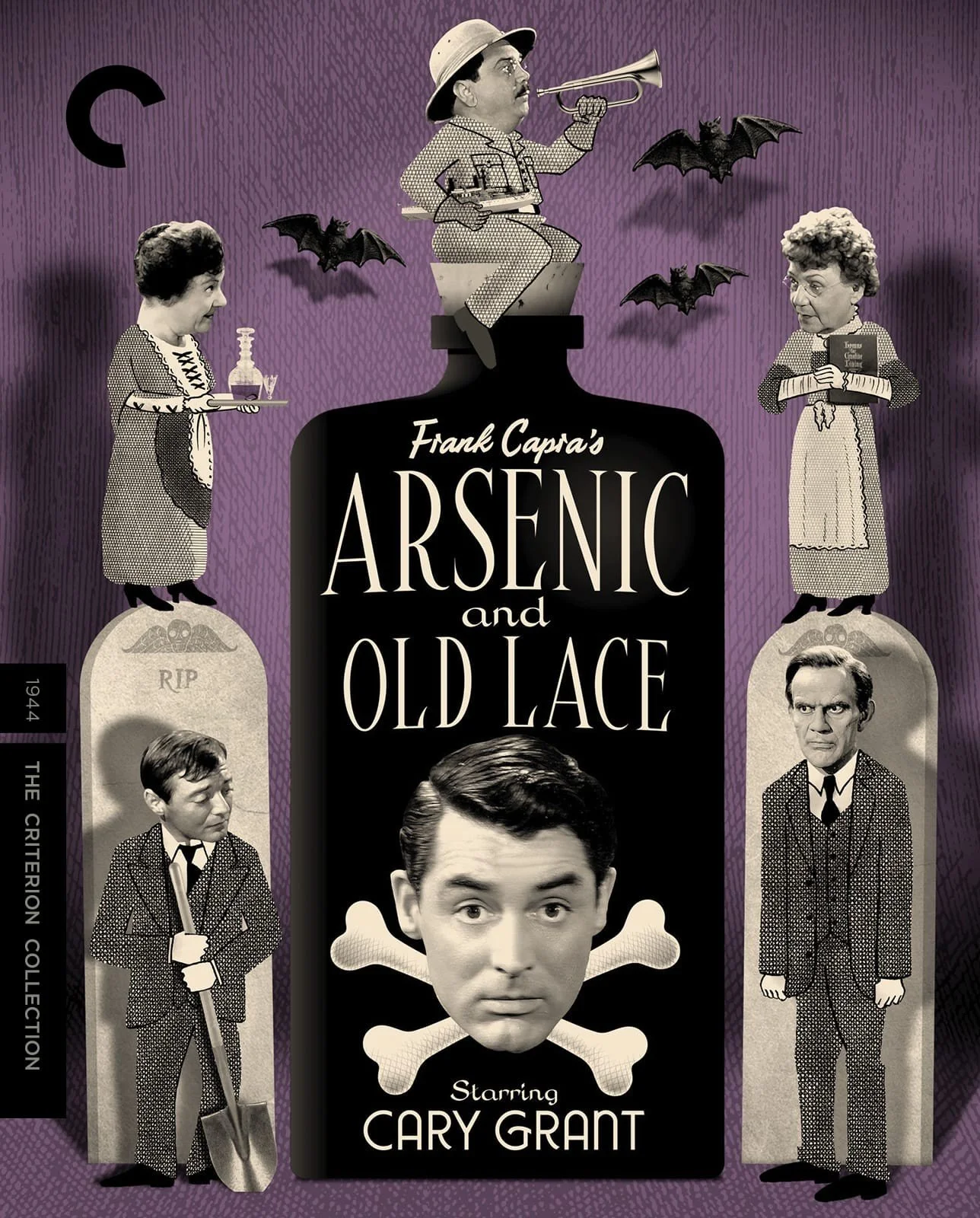
It’s widely agreed that in Arsenic and Old Lace, Capra showed the strangeness of the WASP regime as it developed from its Puritan origins in the early seventeenth century. But this regime was more than strange: it was, by the time Capra chronicled it and as he showed in the film, increasingly empty of all but the trappings of virtue. Standing in the background of American development in Boston and New York and Washington, D.C., WASPs had spent the eighteenth, nineteenth, and twentieth centuries quietly building institutions in imitation of Europe: research universities, philanthropies, foreign policy institutes, administrative agencies, corporations and consultancies. The point of these institutions was mostly the same: to substitute technical instruction by educated elites for the raw, democratic contestation over ethics and interests of a constitutional republic. But WASPs’ marginalized status within America’s irrepressible republic troubled them. It created neuroses, repression, repressed sexuality and homosexuality, physical ailments, mental illness, and the emotional problems that accrued—and led to the depletion of the dynasty which Capra dramatizes in the film.
The tragedy of Capra’s film is that he traced a real conflict but misread its outcome. Before they commenced their fade, the WASPs had one more play to make that, paradoxically, locked in their vision for America. From 1941 through the several decades that followed, they used America’s wars against Nazi and Soviet expansion to put the institutions they had spent the past 150 years building at the center of American life. They also handed off their work to a subset of their elite which expanded it further—their even more ardent and quite fundamentally un-assimilative Jewish Zionist inheritors who have accelerated and inflated their legacy to our collective detriment as Americans.
That Jewish Zionist gloss on the WASP legacy is everywhere today, beginning with the setting of Arsenic and Old Lace: Brooklyn Heights and Dumbo, just across the East River from Wall Street. Those neighborhoods are no longer filled with old houses constructed by WASPs: they are filled with high-rises constructed by Zionists. The old WASP schools like the Episcopalian St. Ann’s send their graduates to Ivy leagues dependent on Jewish Zionist donors. Their old WASP philanthropies have now become theater “warehouses” funded by the Manhattan financial-philanthropic complex dominated by Zionists. Their WASP politicos have become Zionist politicos, namely Hillary Clinton, whose presumptively victorious 2016 campaign had its headquarters in the neighborhood. Their old waterfront areas which once housed warehouses and neighborhoods and small businesses and factories have become, at the hands of Zionists like New York Mayor Michael Bloomberg, Brooklyn Bridge Park: a residential and recreation area where the lawyers and analysts and consultants and H.R. administrators who work for hedge funds and philanthropies go on Saturday and Sundays for picnics and strolls. The unemployed and displaced in these and nearby neighborhoods—among them 64,000 blue collar laborers who lost their jobs in the 2000s, a 46 percent loss that was almost twice that experienced during the same period nationwide—have gone someplace else, displacing others lower on the income scale, who have become homeless.
And this process traces in miniature what’s happened across our country since 1944: not just the assumption of power from one group to another; but the spread of this power so that it disenfranchises the rest of us, those who do believe in Capra’s America. It is this process that has increasingly made us non-citizens, supplicants to our government, strangers in our country, which is increasingly being put to the service of a foreign country, Israel. This process of power accrual and power transition is, largely, an untold story. Knowledge of it is confined to an “elite,” “educated” readership in New York and Washington, D.C. and Boston unlikely to use this information to do what might be construed as “harm” to the WASP-turned-Zionist cause. It’s time for that to change—because these operators, over these years, thanks to their invisibility, have succeeded in doing to us what Cary Grant’s character’s family did to him in Capra’s film, until he snapped out of it. They’ve succeeded in making us think that they have our best interests at heart, that they have the right to rule us, and that they are equipped to do so, when the reality is the inverse.
The reality is that the weirdness and insufficiency of our current politics doesn’t come from us, any more than Cary Grant’s character was the scion of WASPs or than we share the values or interests of Zionists. The weirdness and the insufficiency come from the profound and foreign and quite fundamental weirdness of the people who try to rule us, unconstitutionally and in secret; and who have tried to do this since before the foundation of our republic. It's this profound weirdness and its policy and propaganda outgrowths from which we have to break free to rescue America. But doing that means understanding how this weirdness came to be: how WASPs consolidated power then passed the baton to Zionists, who expanded their remit.
2. The Behind-the-Scenes Rise of the WASPs, 1620-1945
The rise of the WASPs in America began with the arrival of the Puritans: dissenting Christian sects, who docked on rocky outcroppings of Plymouth and then expanded to towns like Newtown (Cambridge) and Boston, creating Massachusetts Bay Colony. Unlike other settlers who came to America looking to achieve independence from arbitrary power, the Puritans had a “higher motive” based on their assumption that they were chosen to establish their settlement by God. In the name of this belief, they set up a community to achieve salvation: giving authority to ministers, building universities to promote classical and religious education and equipping their towns and cities with councils to protect their liberty from the corruption of empire. The communal yet individual character of the Puritan settlements incubated strong, sturdy senses of equality and virtue among their citizens. Yet, as the community enriched itself off commerce with Britain and wars against Indians, its biggest winners took a different approach: families like the Cabots, the Lowells, the Eliots, the Delanos, the Hutchinsons, and the Whitneys who built up influence through commerce and education and connections to the British Empire.
Guilty about their wealth yet unwilling to renounce it, they trumpeted their earthly success as proof of their inherent “chosenness” while waging war against “heathenish” and “barbarous” Indians whom they saw opposing “ordered liberty.” The Puritan ministers, equally concerned over diminishing godliness, enacted ritual punishments to keep citizens in line, and labeled others dissenters and cast them into the Wilderness; one of them, Roger Williams, founded Rhode Island instead.
Over time, the thrust of life in New England was toward concentration of control to the political and economic benefit of this elite and their London connections, and to the detriment of others. Even members of the striving secular upper-middle class were resentful, like John Adams, a Massachusetts lawyer whose father was a shoemaker and farmer and who was caught between Puritan guilt and post-Puritan ambition, and who disliked more influential Bostonians as his undeserving superiors. The American Revolution gave Adams and his allies their chance to right the situation; after coming together with the rest of the colonies to kick their “betters” out, WASPs in Boston and New York saw their opportunity to rule.
They drew behind Adams, America’s first vice president, and Alexander Hamilton, the Treasury Secretary and most powerful official in George Washington’s first cabinet, to realize their vision of a nation run from Boston and New York with a powerful military, high taxes, a national bank, public debt, and national universities to mint an elite to govern the “common herd.” Hamilton was the intellectual and policy driver of this push and a fitting recipient for the task. The son of an illicit marriage in the Caribbean, he pushed into American life displaying an astonishing talent for administrative skills, an astute eye for patronship, and a chip on his shoulder which wrecked him. (He gained power organizing Washington’s army then threatened to resign in the middle of the war when he felt insulted by his commander; married a daughter of one of New York’s most influential families then began a dalliance with another woman which humiliated his wife; and, after losing power, fought a series of duels that ended in his death.) But, whatever the stars or strikes in Hamilton’s personality, he had fervent supporters convinced of the rightness of his cause and their own superior fitness to rule.
Massachusetts Senator George Cabot; New York sugar refiner and State Senator Isaac Roosevelt; Gouverneur Morris, who chaired the commission designing Manhattan’s street grid; Robert Morris, one of America’s wealthiest men—these were members of Hamilton’s class of backers: successful, driven, insulated from the rest of the country. Their surprise was great when the American majority from the south and the west and the “Middle colonies” decisively rejected them in favor of a political ticket headed by Thomas Jefferson, constructed by James Madison, and standing for constitutional democracy via a decentralized republic. To Jefferson and Madison and their backers (small merchants and artisans, unionists and farmers, men of property not tied to empire or finance) the “Revolution of 1800” was a second American Revolution. It realized the promise of the first in the face of a new class of British imitators led by Hamilton who had contrived to steal it in secret from the top-down. This 1800 election was a decisive political rout which put what became the Democratic Party into power until 1860 on a populist policy platform. Boston and New York became outliers in America: refuges for a failed class of leaders denied, as they saw it, their birthright. But they regrouped—corporatively, and from the top down.
In 1810, Francis Cabot Lowell, a product of a marriage between the Cabots and the Lowells, traveled to Britain to realize an ambition of Hamilton’s and steal the blueprints for a power loom. Then Lowell used family money and connections to set up a mill in Waltham outside of Boston, capitalized at $400,000, to take cotton and make it into cheap cloth. Production boomed, profits soared, the mill became a factory town, and the “lords of the loom” like the Lowells quickly gave Southern slavery a new lease on life: empowering the “lords of the lash,” 25 percent of the white Southern population which owned slaves. Within twenty years up-and-comer immigrant entrepreneurs were jumping on the train: among them the German Jewish immigrants Henry, Meyer and Emanuel Lehman (The Lehman Brothers) in Montgomery, Alabama; and the French Jewish immigrants Alexandre Lazard, Lazare Lazard, and Simon Lazard (of Lazard Frères & Co.) in New Orleans. These players used the WASP-driven cotton boom to their advantage. They started trade or dry-goods businesses in the South then moved into finance in Boston and New York, and from there moved to make spots for themselves in the WASP elite.
The Civil War over slavery that resulted from this cotton-driven economy was prosecuted by the Republican Party—then the party of “big government” which owed its existence to WASPs who backed the charismatic frontier lawyer (and Puritan descendant) Abraham Lincoln. The Civil War gave these elite WASPs new opportunities for power by harnessing the national government behind their projects after the War was won. In many ways they weren’t emotionally equippedfor the job of rule. They were described, by critics from their own community, as "ornamental” inheritors who "could scarcely have earned five dollars a day in any modern industry” with faces "like a day-long brooding cloud." Many of them were insecure about their masculinity, “talking tough” in public and exploring homosexuality privately, and mental problems and neuroses were common among them. But their ambition was strong, and so was their pride. They looked down on the associations and legislatures that drove America’s politics, and its large immigrant classes of Irish and Italians who participated, in favor of rule by men “of the better class, who by virtue of intelligence, integrity and business training are specially equipped for the responsibilities of office.” Now they had the chance to show their superiority.
One of their leaders was Charles Eliot, of the original settler family to Massachusetts. Having turned down a supervisory position at a cotton factory in Lowell, Eliot was appointed president of Harvard on the strength of an essay published in The Atlantic Monthly, newly founded by Francis Cabot Lowell’s relation James, arguing that American colleges and universities should adapt their Puritan training in theology, the classics, and other fields to the applied technical skills of empire: business, economics, engineering, and administration. One of the first three PhDs awarded by this new Harvard was to future U.S. Senator from Massachusetts Henry Cabot Lodge, the great-grandson of George Cabot, like his great-grandfather a devotee of Alexander Hamilton. Along with the Massachusetts Institute of Technology, founded in 1861 with support from the Lowells to advance the applied sciences, the growth of Harvard made the Cambridge-Boston area a center of business growth. America’s first consultancy, Arthur D. Little, which advised corporations on psychological and organizational strategies to keep workers efficient and docile, grew in tandem with MIT, and was eventually joined in the city by Boston Consulting Group (BCG), founded by a former Arthur D. Little employee, and Bain & Company, today two of the three most prominent management consultancies in America.
Soon, New York followed Boston’s lead. Henry Jarvis Raymond, a co-founder of the Republican Party in 1856 and a prominent New York journalist, founded The New York Times in an effort to “reform” the Irish and Italian ethnic politics of New York. Edward Cabot Clark, the lawyer who’d shepherded the Singer Sewing Machine from contracts to market, invested in real estate to create the “Upper West Side.” Theodore Roosevelt, Sr., a prominent philanthropist, helped foundthe Metropolitan Museum of Art for the telling “end of furnishing popular instruction.” And it was from New York that the other major WASP leader, who said of Charles Eliot that “he is the only man in the world I envy,” rose to power: Theodore Roosevelt Sr.’s son Theodore Roosevelt, who brought the WASPs back into presidential politics for the first time since the Adamses.
Roosevelt, like Hamilton, thought he had something to prove. He had been born sickly and spent a lifetime demonstrating his martial worth in outsized ways, at the demonstrable expense of other people. Along with Henry Cabot Lodge; Secretary of State John Foster, who set the annexation of Hawaii in motion; and social theorist Brooks Adams, one of John Adams’s great-grandsons, Roosevelt was one of America’s most ardent proponents of elite rule—and he took to the pages of elite magazines like The Atlantic arguing for “the better sort” to affect civil service reform at home and lead wars abroad to “steward the backward races of the world.” Starting with what one of Roosevelt’s confidantes called the “splendid little war” against Spain in Cuba and proceeding to the bigger and more brutal war of attrition in the Philippines, Roosevelt got his wish. This, in turn, propelled him to notoriety and the Vice Presidency and then the Presidency, where he enacted a colonial agenda from the top down. From the White House and de facto bypassing Congress, Roosevelt founded the FBI with the help, perhaps tellingly, of Napoleon’s grand-nephew Attorney General Charles J. Bonaparte, like Roosevelt a Harvard graduate. Roosevelt also acted to eliminate “bad” monopolies while leaving corporate power intact; and took measures to limit state governments, though not when it came to segregation. (He saw blacks, along colonial lines, as racially inferior.)
During these years of overt political expansion, Roosevelt’s class also expanded its power while diluting its continuity by bringing new members in from different groups.
Some of this dilutive expansion occurred at the hands of acquisitive Protestants and assimilative Jews. In 1896, Adolph Ochs, the son of German Jewish immigrants, bought The New York Times, and via intermarriage to the Sulzbergers, originally descendants of German Jews with much longer American origins, began the ownership of the newspaper that continues to this day. Willard Straight, the New York-born son of a Protestant missionary who made his name in diplomacy and finance, married Dorothy Payne Whitney, of the original Whitney Family which settled Massachusetts; and, off her fortune, founded the magazine The New Republic, which took as its lodestars Alexander Hamilton and Theodore Roosevelt. One of the prominent contributors to The New Republic was Arthur Schlesinger, Sr.: the son of German Jewish immigrants who had converted to Protestantism and become a Harvard professor of history and whose own son, Arthur Schlesinger, Jr., also a Harvard historian, would go on to be a top adviser in the Kennedy and Johnson White Houses.
Some of this dilutive expansion also occurred at the hands of Midwestern Protestants and Catholic arrivistes. Joseph P. Kennedy, the grandson of Irish Catholic immigrants whose father had gained business success in Boston, attended Harvard where he was kept on the outs from its WASP elite, but accumulated wealth and power via his marriage to a prominent Irish Catholic family. He advised Franklin D. Roosevelt before World War II and sent his son John F. Kennedy Jr., a future president, to Harvard to mingle with the WASPs in comfort. William F. Buckley, Sr., a Texan Catholic, used America’s expansion to make his fortune in Mexico, then set himself up in Connecticut in the style of WASPs and made Yale the destination for his son, William F. Buckley, Jr, who become the journalistic force behind Ronald Reagan’s “New Right.” The steel executive Samuel P. Bush, the son of a Yale graduate and episcopal minister who’d made his fortune in the west, came East to set his family up in academics, business, and politics. Samuel Bush’s son Prescott became a U.S. Senator from Connecticut and his grandson and great-grandson, George H.W. Bush and George W. Bush, became presidents of the United States off the mobilization of the “new Right” enabled by Reagan and Buckley. (Not coincidentally, all three Bushes and Buckley were members of the secretive WASP Yale society Skull and Bones—and so was John Kerry, a descendant of one of the original Massachusetts settling families and Bush’s opponent in the 2004 presidential election.)
And some of this dilutive expansion occurred at the hands of Jews whose loyalties increasingly lay with the budding “Jewish national” movement of Zionism. Henry Morgenthau, the son of a German-Jewish real estate magnate, grew up in New York and befriended Franklin Delano Roosevelt not long after Franklin married Eleanor, the niece of Theodore Roosevelt. Around the same time Morgenthau married Elinor Lehman Fatman, the maternal granddaughter of Meyer Lehman of Lehman Brothers; and, equipped with these connections, he went on to a predictably successful career which culminated with becoming Roosevelt’s Treasury Secretary. David Niles, a Yiddish-Jewish son of Boston who was educated in schools created by the Puritans in the 1630s, got his “break” into politics via attendance at a public lecture series sponsored by the WASP elite; from there he went to Washington, and ended up a top adviser to Franklin Roosevelt’s successor Harry Truman. Abram Nicholas Pritzker, the son of Yiddish Jewish immigrants who grew up in Chicago, graduated from Harvard Law School, then returned to Chicago to open a law practice, seeding the ground for his son’s investment in a hotel chain, Hyatt Hotels & Resorts. The Pritzkers’ political involvements would wait until Abram Nicholas Pritkzer’s grandchildren: Penny Pritzker, the main backer of Barack Obama and Obama’s Secretary of Commerce and Joseph Biden’s United States Special Representative for Ukraine's Economic Recovery; and J.B. Pritzker, the Governor of Illinois.
Despite the differences between these new arrivals—assimilationist Jews; arriviste Protestants and Catholics; Zionists—the elite was mostly united under the broader WASP inheritance. That inheritance, of government from the top down for the good of the governed, was more influential in America than it had been at any time since the Puritans docked at Plymouth roughly three hundred years before. But it remained a minority position. In the 1920s, states still took on the vast majority of political tasks and state spending was far above the national government’s. Even at the end of the 1930s—after Franklin Roosevelt swept the Democratic Party to power, displacing Republican dominance and instituting national welfare—national-and-state spending was at parity. What changed everything, what brought the WASP regime from the side to the center, was World War II, prosecuted under Roosevelt, the last and most powerful president directly descended from the colonial elite.
War meant a vast nationalization of power for the purpose of legally sanctioned violence. It meant the construction of the Pentagon; the creation of the Office of Strategic Services (O.S.S.), the precursor to the CIA; the creation by acts of Congress or presidential directives of the National Security Council (N.S.C.) and the National Security Agency (N.S.A.); and the expansion of the FBI. It meant massive national funding for research by universities and consultancies: Harvard received the equivalent of over $700 million today for work ranging from developing psychological evaluations to employing “over six hundred scientists working on defenses against radar detection.” It meant corporate innovations: as when the president of the consultancy Arthur D. Little, which had grown after the Civil War in tandem with MIT, helped develop oxygen masks for flyers of high-altitude warplanes. And, after the war with the onset of the Soviet Union’s expansion, it meant the militarization of the economy (the phrase was “military Keynesianism”) to combat the U.S.S.R. This amounted to the creation of what Franklin Roosevelt and others had predicted would be a “consumer republic”—where government subsidized corporations to produce weapons, and corporations poured their profits into products like tract houses and cars which boosted the economy. Corporate magazines and newspapers encouraged Americans to purchase these products to show their patriotism. This was the virtuous circle created by exactly the tools Jefferson and Madison had warned against and that Adams and Hamilton had celebrated: War and Debt.
These were tools wielded almost exclusively by WASPs via military-intelligence organizations, corporations, consultancies, academia, the media—all institutions WASPs had created now seen as vital to efforts against apparently totalitarian enemies. In their waning days, in other words, the WASPs had won, superseding popular constitutional politics without a whisper. They had become the heroes of America’s story, even though their views of their proper role in America were, to most Americans, far from heroic. Indeed, in 1944, the same year that Frank Capra directed Arsenic and Old Lace, the WASP president of Harvard, James Bryant Conant, criticized a government proposal (later the GI bill) to incentivize education as leading to “the least capable among the war generation…flooding the facilities for advanced education in the United States." The GI Bill became law, but Conant’s successors eventually got their way. In the 1960s, using the Immigration and Nationality Act of 1965, they opened American universities to immigrants with the kind of applied skills they valued, and the same elitist values besides. These were highly educated upper-middle class children from less democratic countries like India and China with very little appreciation for constitutionalism, republicanism, theology, or ethics but a great deal of knowledge in administration, economics, engineering, and business. They were not, in other words, arrivals who would challenge the power of WASP institutions but who would advance it instead.
Secure, then, in their unchallenged primacy, the WASPs could do what they’d wanted since Hamilton: go “all in” for elite empire. The heart of this new empire, its clearest and purest manifestation, was the CIA and its environs in Northern Virginia, just outside Washington. An old plantation on the Potomac, Langley, had been selected as CIA headquarters by Allen Dulles, the first CIA director, whose brother John Foster Dulles was President Eisenhower’s Secretary of State, and whose grandfather John Foster was the secretary of state who had set the pieces in motion for the annexation of Hawaii. Less than 20 miles from what became Langley was the site of the Dulles Airport, named after John Foster Dulles, where state department and CIA operatives took off on missions, creating the “Dulles’ corridor”: a new national security domain helmed by two inheritors of the WASP elite. Top CIA officials bought houses in the area. One was James Jesus Angleton, the head of CIA counterintelligence who’d graduated from Yale; and another was Kermit Roosevelt Jr., a member of the CIA's office of policy coordination whose paternal grandfather was Theodore Roosevelt. Other attendees to parties at these houses were syndicated columnists like The Washington Post’s Joseph Alsop, a distant relative of Theodore Roosevelt’s. These later-day Hamiltons, as sexually conflicted and socially ambitious as their forbears, saw their duty as an isolated and lonely one: waging covert war from a position of privilege to protect American civilization and civilize the world. And they did this, in their fashion, as they saw fit: in Iran, Guatemala, Cuba, the Congo, and Vietnam. All of these interventions or coups or wars were repeats of the Puritans’ “civilizing” war against “heathenish” Indians and Theodore Roosevelt’s “civilizing” war against Filipinos whom he called unfit for self-government—on a far bigger stage with much greater consequences at home and abroad.
But the WASPs weren’t protecting and projecting civilization alone, because, after 1945, they brought a new cohort into the institutions. This cohort was American Jewish Zionists, who, in the words of one scholar from this cohort, “can be seen as successors to the WASPS”: namely, in this scholar’s rather astonishing description, “a small but hugely influential group defined by a combination of religious, ethnic, and cultural characteristics…enjoying the nepotism and cultural familiarity that WASPs once monopolized.” Indeed, it is not a coincidence that the Immigration and Nationality Act of 1965 which locked in James Bryant Conant’s aim of bringing the “right sort” of new arrival into American elite education, was passed during an Administration (the Kennedy-Johnson Administration) stocked with WASP elites and devised and co-sponsored by Congressman Emanuel Celler, a staunch Jewish Zionist.
Thomas Jefferson, among others, had seen the germ of this WASP-Zionist alliance as early as the 1790s, watching the post-Puritan WASPs under Adams and Hamilton try to take control of America. “Our New-England associates,” he diagnosed in a pregnant letter in 1798, “are circumscribed within such narrow limits, & their population so full, that their numbers will ever be the minority, and they are marked, like the Jews, with such a peculiarity of character” that their aims would always be anathema to the American people. Where Jefferson was entirely wrong (and remains so today) was to paint “Jews” with this broad brush, since some of America’s Jews were religious and others were assimilative and only a few had the distinctive sense of post-religious secular superiority adopted by Adams, Hamilton, and their post-Puritan cohort. What changed is that, after 1897, the creation of Zionism spread that sense of secular superiority to a wider number of Jewish elites: the land of “Israel” became their “city on a hill.” United by this conviction, strengthened into necessity by the European genocide, this essentially foreign group quickly outstripped all others—Protestant aspirants, Catholics, non-Zionist Jews—as the arbiters of America’s new empire. They then turbocharged this empire in line with their urgencies and directed it for the benefit of their values and their loyalties.
3. The WASP-to-Zionist Handover, 1945-2025
The assumption of power by new groups as Empire expanded and WASPs waned was inevitable. But the assumption of power by a small group of Eastern European and American operators supporting the creation of a foreign state in the Levant was not inevitable; and it did not come about as a matter of course. In the fall of 1946, David Niles, the Yiddish-Jewish son of Boston who’d risen via WASP support to advise President Truman, wrote to David Ben-Gurion a warning from the White House that “the feeling of guilt for the Holocaust is no longer so great…and the longer the solution to the [displaced persons] problem [is] put off, the more interest will lag.” Over the next two years, Niles and Henry Morgenthau and Ben-Gurion and other insider Zionist players solved this problem by pushing WASPs like Eleanor Roosevelt and WASP’s allies like Harry Truman to make the issue of displaced Jews into the solution of Israel on humanitarian grounds—culminating in the creation of the Jewish state in 1948. Three years after that, in 1951, Ben-Gurion and his chief of intelligence came to Washington and made the strategic case to Allen Dulles and James Jesus Angleton that this new state of Israel could become the Western Asian outpost of anti-Sovietism as “part of the Western world.”
It was in this context of engineered humanitarian sympathy and hard preventative geopolitics that Jewish Zionists entered first elite universities and then the wider imperial apparatus, knowing that their loyalty to Israel was in broad strokes acceptable, respected, baked into the terms of their functioning inside them. Indeed, James Jesus Angleton and other WASP “Philo-Semites” saw Jewish Zionists’ loyalty to Israel as guaranteeing their reliability as minders of the global empire WASPs had created. Some WASPs also had inherited an idea adopted by some Puritans—that the covenantal nation promised to the Puritans in their reading of scripture was similar to the nation promised Jews—and construed this “nation” (again, superficially) to align not with the contemporary understanding of an ancient religious text but directly with a modern world of empires and nation-states. Older-line Jews and more pacific Protestants who disliked Zionism still saw these new arrivals as outsiders committed to knowledge and supported them on these grounds. And this meant that Jewish Zionists entered these spaces secure in very particular priorities of their own.
One testimony to these priorities comes from the memoir of Martin Peretz, who grew up in a Yiddish enclave in the Bronx before becoming a Harvard lecturer; and, having married a descendant of the New York developer Edward Cabot Clark, used WASP money to buy The New Republic and turn the magazine into a mouthpiece for Zionism. According to Peretz, his Yiddish Zionist cohort was, like the WASPs, well educated, but also, like the WASPs and to an even greater degree, filled with “all kinds of contradictions and complexes.” They were “proudly Jewish but almost totally secular” and part of “a community in mourning” after a genocide that had created “a civilization of refugees, shattered at the point of its greatest density and development.” They had a “tension between the urges to merge with America and the urge to be separate from it” and “were ardently for Israel.” They were frightened—"we sensed that Catholics held mysterious immediate power over us” and had an uneasy relationship with Irish and eventually Blacks—but they were also angry. “Fighting was a form, the only form, of bonding” for some, while others “talked politics” so ardently that “someone was always not talking to someone else over something: it was that intense.”
Similar testimony comes from two memoirs of Michael Steinhardt, who grew up in a Yiddish enclave in Brooklyn before starting one of New York’s first hedge funds; becoming the major funder of the Democratic Leadership Council, which put the Clinton Administration into office; and co-owning, with Peretz, The New Republic. Growing up, Steinhardt had the same distance from religion as Peretz: his family “kept the vestiges of Jewish religious life intact” even as they “did not communicate its virtue to me.” Fear, justified or not, was another constant: he grew up in a comfortable and stable neighborhood, but perceived Italians and eventually blacks as threats and even agents of humiliation. Loyalties were also fraught: he and his neighbors found “daily solace” in Israel after the Holocaust but reserved their fiercest criticism for Jews who were “inexperienced in the ways of America.” And Steinhardt experienced his Jewishness only “passively” until the age of 21, holding a gun on a Kibbutz in Israel in 1962. Then, in what he describes as a life-changing moment, “I felt an unfamiliar sense of pride welling up inside me…in being entrusted with the safety of the sleeping kibbutz…in my own willingness to face whatever dangers might be confronting me in the night.”
Operators with wound-up insecurities and superiority complexes, married to conflicted loyalties and sublimated aggressions, are not most people’s idea of a functional governing elite—any more than the WASPs. Still, Jewish Zionists were perhaps the most immediately equipped, based on skills and personalities, to staff the institutions the WASPs had created and expanded. They came from an ethnicity which, by necessity, had made its living off applied analytic skills in Europe for hundreds of years—and consequently they were well-placed for technical white-collar educations. They were also single-minded and insecure and willing to rise in WASP institutions in what WASPs saw as the “traditional” way.
And so, in due course, WASPs made handoffs from these institutions to Zionists. According to his memoir, Martin Peretz first met James Jesus Angleton via an introduction from Teddy Kollek, a Zionist operator and ally of Chaim Weizmann, who knew Angleton during the Second World War. The two then formed what Peretz describes as a social troika in Washington with Simcha Dinitz, Israel’s ambassador to the U.S. Around this time, WASP allies of the Lowells and the Cabots sold The Atlantic Magazine, which had first run Charles Eliot’s essay about “Making Harvard Modern,” to Martin Peretz’s close ally Mortimer Zuckerman, the Zionist Boston real estate developer. Zuckerman’s successor owner, a WASP, appointed as its still-serving editor Jeffrey Goldberg, an ally of Peretz’s, who served in the IDF during the Second Intifada. The Zionist Henry Rosovsky, the Dean of the Faculty of Harvard from 1973 to 1991, who effectively narrowed the curriculum towards even more applied focuses than existed during Eliot’s reign, was selected for his post by Harvard president Derek Curtis Bok, an old line WASP inheritor of a prominent three-generational Pennsylvania family. And Rosovsky’s close ally (and fellow Jeffrey Epstein confidante) Lawrence Summers, the former Treasury Secretary to Bill Clinton and economics adviser to Michael Dukakis, was selected as the first Zionist president of Harvard by a search committee made up largely of WASPs, among them a descendant of one of the original settlers to Cambridge.
Older, elite, non-Zionist Jews who’d assimilated into the WASP echelons made hand-offs to Zionist Jews as well. Henry Kissinger, a non-Zionist German Jew who’d begun his ascent teaching at Harvard, was convinced during the Yom Kippur War in 1973 by Simcha Dinitz, Peretz’s and Angleton’s confidante, to throw America’s support to Israel— cementing Israel’s and America’s “special” relationship. Felix Rohaytn, an Austrian-Jewish immigrant who had risen to become the leading rainmaker at Lazard Freres, the firm founded in New Orleans in 1848 at the height of the cotton boom the Lowells helped generate, was in 1975 the main instrument behind rescuing New York City from bankruptcy on terms which effectively shifted city government from subsidizing welfare to subsidizing finance. This, in turn, put Michael Steinhardt and Steinhardt intimates (and Rohatyn devotees) like Michael Bloomberg into clover. Starting in the 1970s, WASPs or WASP-Jewish loyalists of Joseph P. Kennedy’s son John F. Kennedy, among them Arthur M. Schlesinger Jr., brought the “Kennedy mystique” to Harvard via the expansion of the Kennedy School of Government: the special project of Derek Bok. And it was the 42-million dollar beneficence of Rosovsky’s intimate’s Jeffrey Epstein’s patron Leslie Wexner in the 1990s and 2000s that helped make the Kennedy School a force to be reckoned with, even as Wexner was also instrumental in the events that led Michael Steinhardt to found Taglit- Birthright—to offer young Jews outside of Israel a free visit to the country— today the largest educational tourist organization in the world.
So far, all of this is not outside the norm in highly insular imperial elite circles. But, in the years following their initial entry and rise, the movement of these outsider players with exotic loyalties and specific lodestars had about it something unusual. Using their interconnections to each other and to Israel, they established power astonishingly quickly and at the demonstrable expense of other groups (Catholics, new Protestants, assimilated Jews) that had been allowed into the WASP elite.
A few of many examples make the point plain. According to his memoir, Martin Peretz first met Abram Nicholas Pritzker, the founding member of the Pritzker Family, which owns the Hyatt Hotels, fundraising for Israel; and not long after, at Pritzker’s request, began “to look after” Pritzker’s grandson J.B. Pritzker, then a boarding school student in Massachusetts and today the Governor of Illinois, whose sister, Penny Pritzker, was the crucial financial and social backer who facilitated Barack Obama’s rise. (“Without Penny Pritzker,” The New York Times wrote in 2012, “it is unlikely that Barack Obama ever would have been elected to the United States Senate or the presidency.”) Another of Peretz’s Harvard protégés, Al Gore, was along with Michael Dukakis and Bill Clinton in the late 1980s and early 1990s the preferred candidate of the Democratic Leadership Council, the group created by the Zionist Al From and funded most heavily by Michael Steinhardt. With help from the Zionist co-owners of Dreamworks David Geffen (another Peretz connection) and Jeffrey Katzenberg, the DLC put Bill Clinton, the DLC’s chairman in 1990 and 1991, into the White House. (“I would have never become president if it wasn’t for you,” Clinton told From, the founder of the DLC, a decade and a half later.) These were the supportive structures that set the terms for the presidential campaigns or presidencies of Michael Dukakis, Bill Clinton, Al Gore, Barack Obama, Hillary Clinton, Joe Biden, and Kamala Harris.
Other, similar connections circled and intersected on the political Right. It was Peretz, who, according to his memoir, first met Benjamin Netanyahu—already known as the son of an ardently Zionist scholar at Cornell and the brother of a famously martyred IDF officer—on a tour of the Golan Heights in the 1970s. And it was Peretz who took Netanyahu out to lunch—much as he took Pritzker out to lunch—in Cambridge that same decade when Netanyahu attended MIT and worked at Boston Consulting Group (BCG), then only recently founded by an employee of Arthur D. Little. It was Netanyahu who used this stint to cultivate ties with such future allies as Mitt Romney, a fellow BCG consultant who decades later would say of Netanyahu that “We can almost speak [to each other] in shorthand” thanks to what Netanyahu called “BCG’s intellectually rigorous boot camp.” This demonstrable comfort with the American elite allowed Netanyahu, in his thirties, to return to America from Israel in the 1980s as Israel’s Ambassador to the United Nations; and it was from this perch that he met and became close to the casino magnate Sheldon Adelson and the real estate magnate Charles Kushner. Thirty years later, Adelson’s wife Miriam and Kushner’s son Jared are arguably the two most influential Zionist political players in America: the people whom Netanyahu used to secure the Trump Administration’s aid and permission for the genocide, razing, and rebuilding of Gaza.
These connections bore outsized political fruit, as a set of superficial yet telling statistics makes plain. From 1988 to 2024, fourteen candidates ran on a major party ticket for President of the United States. Four of them—George H.W. Bush, George W. Bush, John Forbes Kerry, and John McCain—rose from their statuses as WASP inheritors or scions of the WASP empire’s hereditary military elite. Nine others were, decisively though not solely, products of Zionist backing. Michael Dukakis, Bill Clinton, Al Gore, Barack Obama, Hillary Clinton, Joe Biden, and Kamala Harris owed the terms of their ascent to Steinhardt’s Democratic Leadership Council, the Pritzker Family, Hollywood players like Geffen and Katzenberg, and Peretz’s The New Republic. Mitt Romney and Donald Trump, whose earlier careers intersected decisively with Zionist operators like Benjamin Netanyahu and the Kushners, ran their campaigns in 2012, 2016, and 2024, with help from and with the largesse of Zionists, among them the Kushners, Paul Singer, and Sheldon and Miriam Adelson.
It ought to be emphasized that this is only a fractional list of Jewish Zionist players whose influence ran through politics over these candidacies and these presidencies in exactly these ways—and it is Israel that explains the astonishing assumption of power at work in these sequences. Jewish Zionists were not, like the WASPs, people of slightly different political priorities (Alexander Hamilton pro-corporate; Franklin Roosevelt pro-welfare) linked to each other through long family ties or ties to the country. Nor, like earlier elites, including Jews or Catholics or Protestants who joined the WASPs, were they linked by an intent to assimilate. They were linked as Jews who shared an understood commitment to Israel as the apex of their religion and their culture. And it was this commitment that drew them to each other above other elites and other Jews and motivated their coalescence as a distinctly political force. This key similarity is testified to by the players themselves in extremely overt ways.
Martin Peretz and Michael Steinhardt met, in Peretz’s recounting, in 1979, at Grand Central Oyster Bar, which goes against kosher. Ppredictably, they bonded not over religion but over Peretz having read a New York Times article about Steinhardt, which described him “as a Jew whose fealty to Israel is deeply felt.” Steinhardt, for his part, recorded in his first memoir postponing the launch of his hedge fund when the Six Day War broke out, on the logic that “My good fortune surely could not coexist with Israel's misfortune.” In the acknowledgments to his second memoir reflecting on the centrality of Israel to what he sees as the Jewish tradition, Steinhardt thanked Miriam Adelson prominently as “Miri,” as well he might; both are on record describing support for Israel as a “sacred duty” for Jews, with Steinhardt going so far as to say that “Israel has become, for me, the substitute for religion.” For Adelson, “her own inner strength, she believes, is genetic,” by which she means that since “all [our grandparents] were lost in the Holocaust…we grew up knowing…it was important just to survive.” The Kushners take a similar line: according to a New York Times profile of the family (“For Kushner, Israel Policy May Be Shaped by the Personal”), “The Kushners’ Judaism and support of Israel were one and the same, friends said: about ensuring survival.”
Under the influence of these single-minded players, the contours of politics beginning in the 1990s changed accordingly, dramatically, and in traceable and highly specific ways. As they emerged into power, Jewish Zionists adopted two political lodestars from the WASP elite which worked, consciously or not, to reinforce their aims.
The Zionists’ first lodestar was Civil Rights, based on adopting from their collegiate years what Peretz called an “edifice complex”: “the idea that if we built enough lasting monuments in America, distinctly Jewish yet universally tolerant, it would save us from the next Hitler.”
In practice, the Zionists’ focus on Civil Rights worked to their advantage, since it functioned in American law and social life to turn casual criticism of any religious or ethnic group or their subsidiaries (like Zionists) into discrimination. Zionist Jews like Peretz were active in the Civil Rights movement from the beginning, and they have assiduously expanded Civil Rights’ reach since. Peretz’s The New Republic is known for bringing a focus on gay marriage as an issue of Civil Rights to Washington, and it is directly off the efforts of David Geffen (a Peretz ally), Jeffrey Katzenberg, and most influentiallyof all the Pritzkers and their close ally Hollywood Zionist Rob Reiner that LGBTQ+ rights and specifically transgenderism have become Democratic touchstones in the Civil Rights framework. Today, the opposite-but-equal tack is being taken by pro-Zionist institutions or operators tied to the Trump Administration and one or two degrees removed from The Democratic Leadership Council and The New Republic who also identify with the Civil Rights tradition: among them Bari Weiss’s Free Press; the Manhattan Institute funded by Paul Singer; and the Federalist Society’s Leonard Leo. These operators are making discrimination against white Christians an issue of civil rights, and conservative cultural politics the business of Hollywood. Intentionally or not, all of this identity politicking functions to keep law firms and production studios in clover and the rest of us distracted from the concentration of power led by these various Zionists at the top.
Zionists’ second lodestar was what they erroneously called the “free movement of goods and people.” This meant the encouragement of immigration to secure low-cost labor along the logic that this encouragement, along with government generosity toward finance, would guarantee low consumer costs—what Peretz called, misleadingly, “the passion of democratic capitalism.” If insiders like Lawrence Summers and Penny Pritzker and their assorted allies largely set the terms of what was misleadingly called “free market” development in the Clinton and Obama and Biden Administrations, it is Jared Kushner and his allies who are setting similar terms with the equally misleading label “America First” under Donald Trump. The commercial developments helmed by Saudi Arabia and the United Arab Emirates being brought to South Florida and New York and the West Coast and pockets of the rest of the country by Kushner and other Zionists are different in label but not in kind to the low-cost suburbs built in the 1990s and 2000s off the support of too-big-to-fail financial firms connected to Lawrence Summers and Robert Rubin and other Jewish Zionists using unsustainable home ownership loans. And the hatred stirred up against law-abiding illegal immigrants by Kushner’s Zionist ally Stephen Miller is a mirror image of the hatred stirred up by J.B. Pritzker in Illinois against those Americans who object to illegal immigration. Again, the more Americans are divided, the clearer the field that exists for a tiny Zionist elite with shared loyalty to Israel to run its plays in America’s military corporate complex for the benefit of a foreign nation.
Indeed, by using law and capitalism to erode Americans’ religious and communal identities and create friction between groups, Jewish Zionists have functionally if not necessarily intentionally created an empire whose citizens are distracted and divided even as that empire effectively serves the strategic benefit of Israel. Since the beginning of the Clinton presidency in 1993, Israel has gone from being an ally against Sovietism to, arguably, the primary determinant of our foreign policy. We have intruded or involved ourselves or outright intervened on Israel’s behalf or to Israel’s benefit or thanks to the influence of Zionist Americans against Muslims in a “War on Terror” that, in the accounting of its most encyclopedic and comprehensive chronicler, Scott Horton, has spanned Somalia, Saudi Arabia, Afghanistan and Iraq after 9/11, Libya, Syria, Pakistan, Palestine, and Iran. We have seeded Israel’s technology boom, and brought its technologistsinto our defense-technology apparatus run out of Silicon Valley. We have adjusted government policy via “tax exemptions, direct grants, and legal permissiveness” in ways that favor philanthropies for Jewish Zionist genetic continuity pushed by Michael Steinhardt and others. And, in the face of the recent rising backlash against these insider plays, we have adjusted our enforcement of speech codes and weaponized our laws to make criticizing Israel and its influence—and by extension meaningfully criticizing America’s elite—into hate crimes.
Zionists’ justifications for these top-down moves are not too different than the justifications Puritans and WASPs made to exterminate Indians or invade the Philippines or make war in Southeast Asia. A new battle of civilizations, we are told, is upon us in a “new world,” one defined by a war between the savage and civilized. While Muslims are in this telling the “uncivilized” abroad, at home the battle is against the “uncivilized” ardors of popular constitutional democracy: whether Muslims in Dearborn objecting to Zionists bombing their homelands or African American Christians (and non-Christians) connecting their struggles to Palestinian ones or white Christian conservatives protesting Zionists’ influence on Trump. No matter the identity of these objectors, their populist character is, as Martin Peretz wrote recently about populism to a different point, “by definition a threat to institutional stability.” And Zionists make this case, for the desirability of the “institutional stability” they uphold, even as the sexual depredations against defenseless minors perpetrated thanks to inducements by members of their cohort put the WASPs’ own dalliances to shame.
What explains, and enables, this brazenness? Eighty years of anti-Capra propaganda meant to convince us that the evidence of our eyes is inadmissible compared to the words of our ruling elite. This propaganda is everywhere—and it is very different, in fact it is 180 degrees inverted, from the themes of a movie by Frank Capra, whose vision of America, tellingly, is openly dismissed as unrealistic by one of America’s most prominent Zionist media operators. This propaganda is not just a rewriting of values but of the history that created those values. Its function is to convince listeners, readers, and viewers that those values of Capra’s we believe in—commonsense, community, the basic tenets of calmness and character—are wrong, and that the opinion of a hyperkinetic and oddly driven set of elites is the only opinion worth listening to or holding.
4. Anti-Capra Propaganda—and How to Fight It
As with earlier Zionist innovation of power and policy from WASP invention, the genesis of this propaganda is America’s original ruling elite.
It was Theodore Roosevelt, whose backers took for their model Alexander Hamilton, who created what historians call the “rhetorical presidency”: a “validation-by-action” model of leadership in which the candidate or the President, “the man in the arena,” makes himself the star of the American “show” by charging up San Juan Hill (a fictionalized anecdote purveyed by reporters because Roosevelt “was great copy”) or bagging wild animals on Safari or giving endless speeches to make the presidency into the “bully pulpit.” It was Arthur Schlesinger, Jr., the son of the writer for Roosevelt’s media backer The New Republic, who along with Richard N. Goodwin defined John F. Kennedy’s presidency based on Kennedy’s rhetoric in “dramatic settings” like Capitol Hill and Berlin and Miami. It was Arthur Schlesinger Jr.’sideological sparring partner William F. Buckley, Jr., the son of the entrepreneur who made his pile in Mexico and sent his son to Yale, who became the decisive intellectual backer of the next great “rhetorical” president, Ronald Reagan, and who devoted much of the rest of his energies to convincing audiences of the high school conflation that using big words is the same thing as exercising intellect. It was Doris Kearns Goodwin, the wife of Richard N. Goodwin, who turned her talents as a popular historian to indelibly memorializing as American heroes the WASP-friendly or WASP quartet of Abraham Lincoln, Theodore Roosevelt, and Franklin Delano and Eleanor Roosevelt. And it was David M. McCullough, a graduate of Yale and a member, like Buckley and the Bushes, of Skull and Bones, who wrote an admiring biography of Theodore Roosevelt as well as a history of Roosevelt’s celebrated colonial construction project, the Panama Canal, followed by two bestselling biographies resuscitating the reputations of John Adams, the first WASP president, and of Harry Truman, who created Israel.
But, in window-dressing as elsewhere, it is with the Zionist assumption of power since the 1990s that this valorizing of elite operators has taken on a frenetic, aggressive character.
The inception of this process was the Clinton presidency. In 1999, the Hollywood Zionist Aaron Sorkin created the television series The West Wing in the image of an idealized Clinton White House— most notably in the image of Rahm Emanuel, a Jewish Zionist of long family heritage with connections to Martin Peretz of The New Republic. The West Wing was the television series famous for its “walk-and-talks” in which presidential aides from the Ivy leagues or “elite” state schools move from room to room and talk about running the country. Its genesis was twofold: a suggestion from St. Ann’s School legacy graduate Akiva Goldsman, a Jewish American with deep Zionist connections; and Sorkin’s own deep ties to the Clinton White House via two Hollywood operators, Rob Reiner and Chad Griffin, who would later become powerful pushers of LGBTQ+ issues in the Obama-Biden presidencies. The series became enough of a staple that, besides seeding the careers of other Sorkin acolytes who specialize in portraits of rhetorically able genius-analysts, it brought new players into politics. Peggy Noonan, a Zionist ally and Reagan’s former speechwriter who helped make his rhetorical presidency, has said that she thinks that political operators today model themselves after The West Wing’s characters.
Among the ones so inspired is the Zionist New York Times op-ed writer Ezra Klein, who agreed that The West Wing’s “rat-a-tat brio” and “star-spangled emotion” and most of all its “vibe” ("Smart, smart, smart!... Busy, busy, busy!”) pushed against the “suggestion that Washington is boring, that policy is boring.” Certainly Klein does something similar to Sorkin at The Times, especially through his podcast: he makes “experts” into the “cool things to be.” He does this even when the expertise he features isn’t actually knowledge so much as new applications of the old WASP passion: using applied skills to bring institutional power to bear on regular people at the expense of democracy in the name of the “common good.” The political epitomizer of Klein’s op-ed tactics has so far been another Times’ op-ed contributor, Zionist Ben Rhodes: the speechwriter for the man considered America’s last “rhetorical president,” Barack Obama. For Rhodes, who in his own telling was “a bridge between [Obama’s] speeches and his actions,” Obama, “a man who had been a U.S. senator, a constitutional law professor, and the first African American to lead the Harvard Law Review,” was the epitome of the American order of Civil Rights, free markets, and free peoples so assiduously promoted by Zionists: “a successful two-term African American president and a vessel for the aspirations of billions of people around the world.”
Still, the pinnacle of Zionist valorization of the elite is not a real leader but a fictionalized one: Alexander Hamilton of the eponymous musical, arguably the most significant recent piece of American “high-popular” culture which valorized as America’s quintessential founder the first articulator of the American elite’s imperial dreams. The music for Hamilton was, famously, written by Lin-Manuel Miranda, a Puerto Rican-Mexican American from the Bronx; and its cast is mostly made up of actors of color. But the shapers of its story were Jewish Zionists or their acolytes: Ron Chernow, who wrote the biography on which it was based; and Jeremy McCarter, who encouraged Miranda in his writing and ushered in the first performance of the musical at New York’s Public Theater, then co-wrote with Miranda a bestselling book about the musical. Both men were well-equipped by their histories for their tasks. Chernow had, prior to the Hamilton biography, written biographies of three WASP and German-Jewish financiers or financial families who’d expanded our elite before the Second World War. McCarter had, prior to the Hamilton production, worked at Martin Peretz’s New Republic.
The elitist message of Hamilton is the message of the people who back Chernow and McCarter: the people who took over Cary Grant’s character’s family’s neighborhood, and who took over the Manhattan neighborhoods across the river that had been built up by the Roosevelts and the Delanos and the Clarks. To resist the message of these Zionist interlocutors is to confirm one’s status as, in the words of Aaron Sorkin about the Tea Party the “American Taliban”—and it is not a coincidence that Jewish Zionists obsessed with declining numbers define Christians and Muslims, the two great majoritarian faiths, as their ultimate enemies.
Nor is it just religion that is, in the Zionist schema, the enemy. Thick communities, the primacy of family, the necessity of self-government—all of these features of a constitutional Republic are what Zionists want us to forget, what they gaslight us into forgetting, just as Cary Grant’s character was gaslit by his family in Arsenic and Old Lace into “forgetting” what they’d done before he disowned them. Rescuing America and restoring it to an approximation of Capra’s vision, the vision that at some level most of us share, no matter our particular policy preferences, means disowning our Zionist rulers—and disowning the legacy they’ve inherited and inflicted—unseen, unknown, and undetected—upon us.
By Matt Wolfson: website: Opposition Research, x: @oppo__research.com
Note: The views expressed in the essays section of aza-pac.com are not necessarily those of AZAPAC.